A Commentary on Symbolic Tribalism
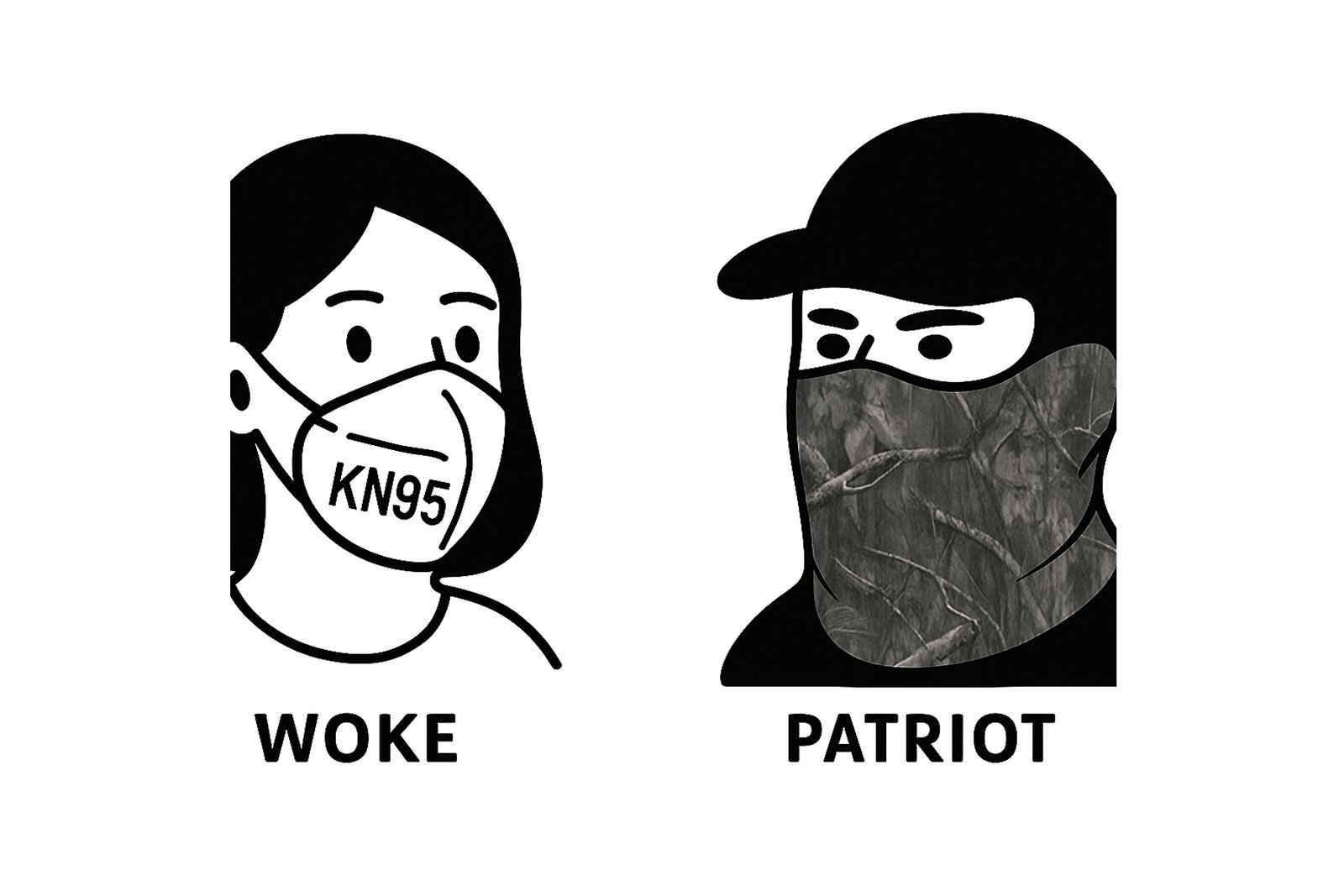
In an era dominated by memes, shorthand labels, and rapid-fire judgments, the image highlights a central truth: politics has become saturated with symbolic tribalism. People are no longer evaluated by their values or reasoning but by instantly recognizable visual cues:
-
Mask with printed “KN95” → categorized as “woke”
-
Camouflage face covering and hat → categorized as “patriot”
These symbols function as cultural uniforms. Once worn, they trigger immediate assumptions about one’s beliefs, loyalties, and worldview.
The Mask as a Cultural Divider
The person on the left, wearing a KN95 mask, embodies a public-health-conscious persona. But in America’s culture wars, such a mask has been reinterpreted as a signal of political alignment. Instead of prompting discussion about community safety, science, or policy, it has become shorthand for a particular ideological camp.
The image suggests that even neutral behavior — protecting one’s health — has been politicized.
Camouflage as an Identity Marker
On the right, the figure wearing a camo-patterned face covering and cap evokes rugged individualism, self-reliance, and a certain brand of patriotic aesthetic. For many, this symbolizes loyalty to traditional values or skepticism toward government authority. But the illustration critiques how easily such symbols can be used to create caricatures of political identity rather than authentic representation.
The camo covering, originally meant for hunting or tactical use, becomes a cultural badge — not just apparel.
A Satire of Simplistic Labels
Placing the words “WOKE” and “PATRIOT” directly beneath the images exposes how reductive these labels have become. The illustration points out the absurdity of defining entire ideological identities using nothing more than face coverings during a global health crisis.
This reduction of identity into visual stereotypes fuels polarization by:
-
trivializing complex political beliefs
-
encouraging snap judgments
-
rewarding caricatures over nuance
-
reinforcing “us vs. them” narratives
The image underscores a sobering reality: modern political discourse frequently revolves not around ideas but around symbols that require no thought and provoke maximum reaction.
The Deeper Message: When Appearance Replaces Argument
The illustration serves as a stark caution about the erosion of meaningful political engagement. When simple visual elements become ideological markers:
-
genuine dialogue declines
-
empathy disappears
-
individuals become avatars of a team rather than people with layered beliefs
This dynamic undermines democratic discourse and hardens people into echo chambers where dislike is directed not toward ideas, but toward images.
Conclusion: Beyond the Mask and the Meme
The artwork makes a sophisticated critique of identity politics in the digital age. By pairing two stylized figures with polarizing labels, it reveals how quickly society collapses complex identities into cartoon binaries. In doing so, it challenges viewers to look deeper than the masks people wear — literal or symbolic — and to rethink how we categorize one another.
Political maturity begins when we stop confusing a symbol for a person and start examining the ideas beneath the imagery.