
A Table Set for Generosity — or Strategy?
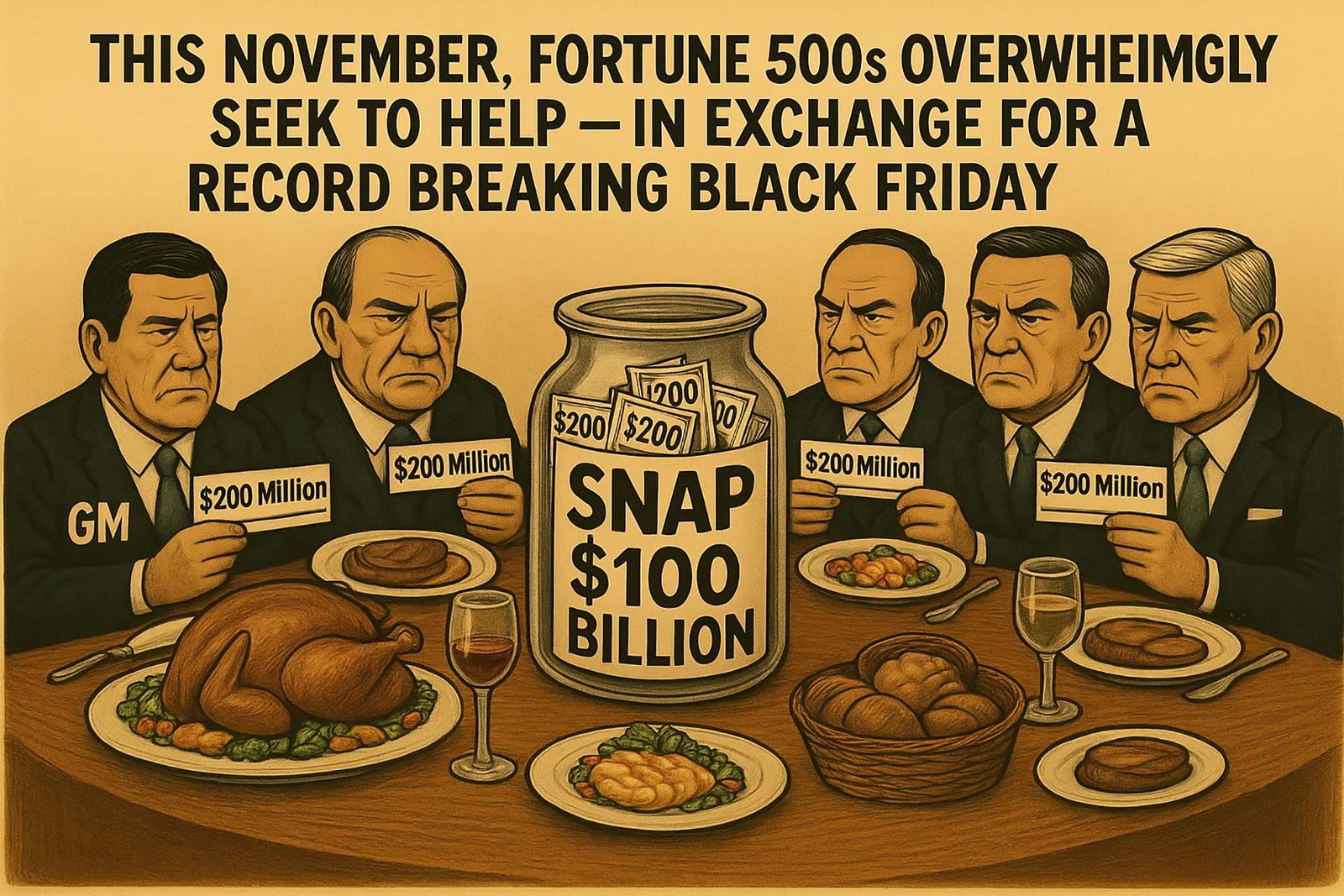
Five stern-faced corporate executives sit around a dinner table, each holding a sign that reads “$200 Million.” None appear truly charitable or even remotely enthusiastic; instead, their expressions are flat, cold, and businesslike. In the center of the table stands a massive jar labeled “SNAP — $100 BILLION.” It’s overflowing with cash.
The message is loud and clear:
While these large corporations appear to offer “help,” it’s framed as a minuscule contribution compared to the enormous scale of America’s food-assistance program. Their combined $1 billion symbolic offering is dwarfed by the $100 billion need.
Black Friday: The Unspoken Exchange
The headline in the illustration exposes the implied quid-pro-quo:
“Fortune 500s overwhelmingly seek to help — in exchange for a record-breaking Black Friday.”
Here lies the core critique:
Corporate “philanthropy,” particularly in election season or holiday season, often parallels marketing campaigns. Help is offered, but not without expectation. In this case, it suggests that corporate lobbying and public-image initiatives conveniently align with consumer-spending holidays.
Aiding low-income families during November doesn’t just look good — it fuels the very season that delivers corporations their highest profits.
A Feast for Them, Scraps for Everyone Else
The contrast in the illustration is striking:
-
The executives have plates, cups, wine glasses, and bread baskets around them — a full feast.
-
But their plates are nearly empty. This may symbolize that despite enormous wealth, their contributions to public welfare remain intentionally modest.
-
Meanwhile, the giant jar at the center represents the vast scale of need — the real “meal” the nation requires.
The turkey, rolls, wine, and side dishes aren’t really food here — they symbolize prosperity. Yet the corporations sit around the table as though they are reluctant participants in sharing any of it.
The Subtle Power of Satire
The piece uses satire to challenge viewers to ask:
-
Are corporations contributing out of compassion — or calculation?
-
Why must public hunger relief rely on the same companies that profit from holiday consumerism?
-
Is charity being weaponized as a bargaining chip for political or economic gain?
-
What motivates Fortune 500s: community good or record-breaking Black Friday revenue?
The stiff postures and grim expressions of the suited men aren’t accidental. They imply reluctance, disinterest, or even annoyance — visual clues that their “generosity” is more of an investment than an act of goodwill.
A Commentary on the SNAP System Itself
Placing SNAP — a program feeding millions — inside a jar labeled “$100 Billion” exaggerates the contrast between:
-
public need,
-
and corporate contribution,
-
and the political narratives surrounding welfare.
It suggests that while corporations gesture toward support, the actual burden falls on taxpayers and government systems — not boardrooms or billion-dollar brands.
Conclusion: Giving or Gaming?
The illustration exposes an uncomfortable truth:
In American politics and corporate culture, philanthropy is often entangled with profit. The timing of generosity — November, right before the holiday retail frenzy — adds to the cynicism.
This is less about helping families in need…
and more about helping the bottom line.
At its core, the image asks viewers to rethink the motivations behind corporate kindness:
Is it compassion — or commerce masquerading as care?